

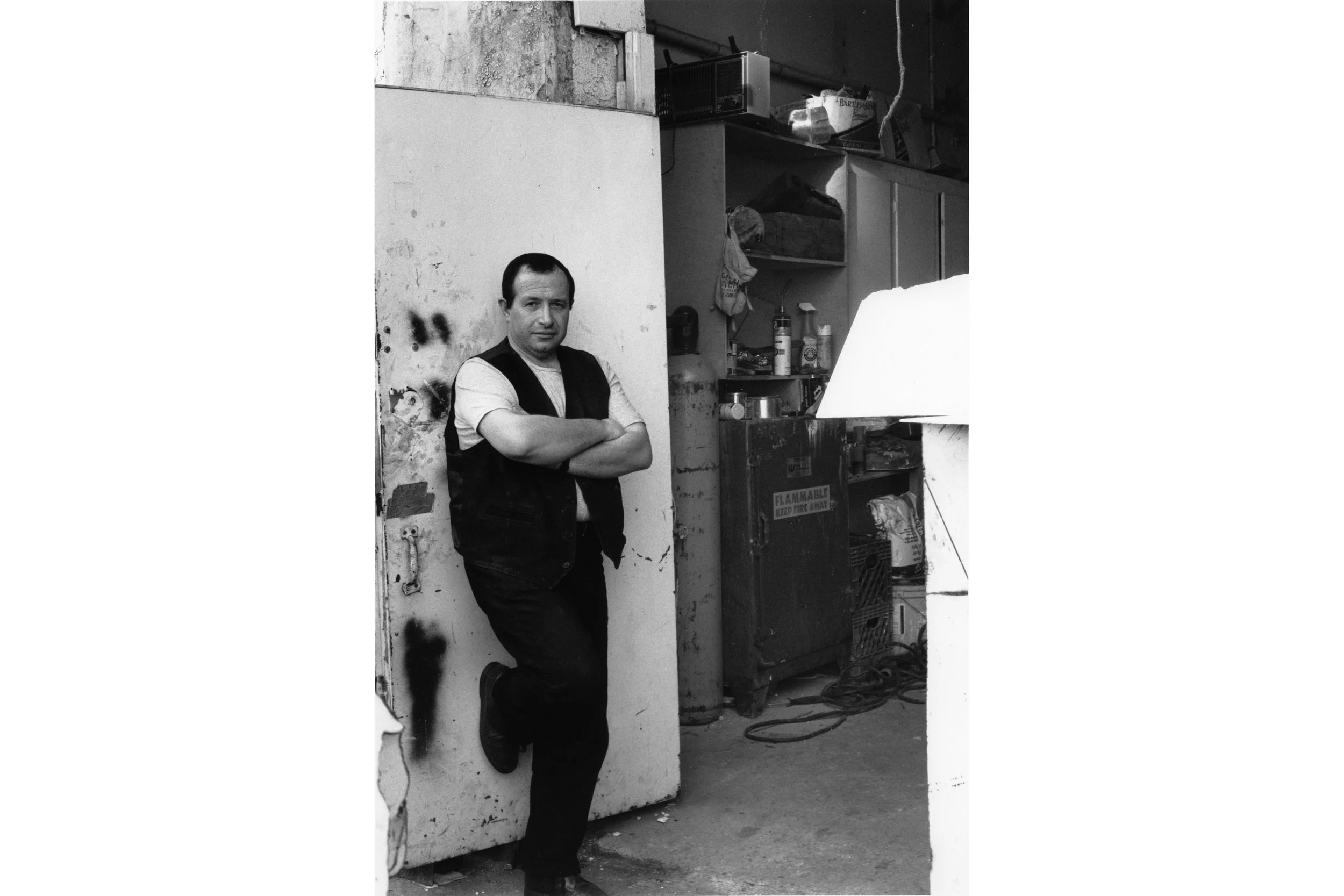
Alain Kirili (born 1946) was a French-American sculptor of verticality and abstract modeling – “abstraction of the flesh” – whose work turns on the relationship of sculpture to the body, to sexuality, to circumvolution, and to music; particularly the music of “free jazz” which he loved passionately and supported through events held in his Tribecca loft in NYC.
Kirili began showing with Sonnabend gallery in 1972, in Paris, and subsequently in New York. In 1976, while travelling in Austria, he developed a deep interest in blacksmithing that would play out across his career. He and his partner, photographer Ariane Lopez-Huici, moved to New York City in 1978 to be closer to those artistic currents which were exemplified by Barnett Newman and David Smith, among others, and which felt so vital to them. From this time on, Kirili’s incessant movement between New York and Paris would become a symbol of freedom and an inspiration for him, as he rooted himself in a tradition of French statuary while engaging the New York artistic landscape, remaining as committed to verticality and sensuality as he was opposed to the “puritanism” that he sensed in the contemporary scene.
Kirili’s frequent travels brought him to India and to Mali, among many other places, where he developed a vibrant enthusiasm for the Yoni-Lingam sculptural representations of Shiva, as well as the blacksmithing and sculptural tradition of the Dogon people. He carried these living references with him, as he did the figures and music of those free Jazz musicians he wrote and spoke so frequently about – Cecil Taylor, Steve Lacy, John Coltrane, Roy Haynes, Ornette Coleman…and the list goes on. Over several decades, Kirili and Ariane Lopez-Huici hosted collaborative jazz and dance concerts in their New York loft, in which musicians would often improvise around Kirili’s own work in an intense and revealing dialogue that Kirili referred to as a “communion.” These collaborative happenings were at the center of how Kirili thought about sculpture and its relationship to music, to rhythm, and to the expressive body.
Throughout the 80s, 90s, and 2000s Kirili continued to show in New York and Paris, among other places, and his work came to be held in the collections of many prominent institutions, including of the Museum of Modern Art, the Georges Pompidou Center, the Jewish Museum in New York, the Nasher Collection in Dallas, the Institut Valencià d’Art Moderne, and Art OMI in New York, among others. On several occasions, he was commissioned to create public and permanent sculptural installations that can be found in Paris, Grenoble, Dijon, and Montmajour, in France, as well as at Art OMI, in New York. Often executed in Burgundy Limestone, these commissions allowed him to articulate a monumental dimension to an oeuvre that was already characterized by diversity of both scale and material. In the late 90’s, Alain Kirili was commissioned by the French Ministry of Culture to install 20th Century sculpture in the Jardins des Tuileries, in Paris, where his own sculpture, “Grand Commandement Blanc,” 1985, was permanently installed.
Kirili passed away in his New York loft on May 19, 2021. He was 74 years old. He is survived by his wife and life-long artistic partner, the photographer Ariane Lopez-Huici, and he leaves in his wake a legacy of intense cross-disciplinary collaboration and inspiration that celebrates the creative impulses of the body. As he stated in one of his last interviews, referencing the eroticism of certain Hindu temples, as well as that of Italian Catholic iconography: “when you bring together sexuality and spirituality, you are in masterpiece mode.”